






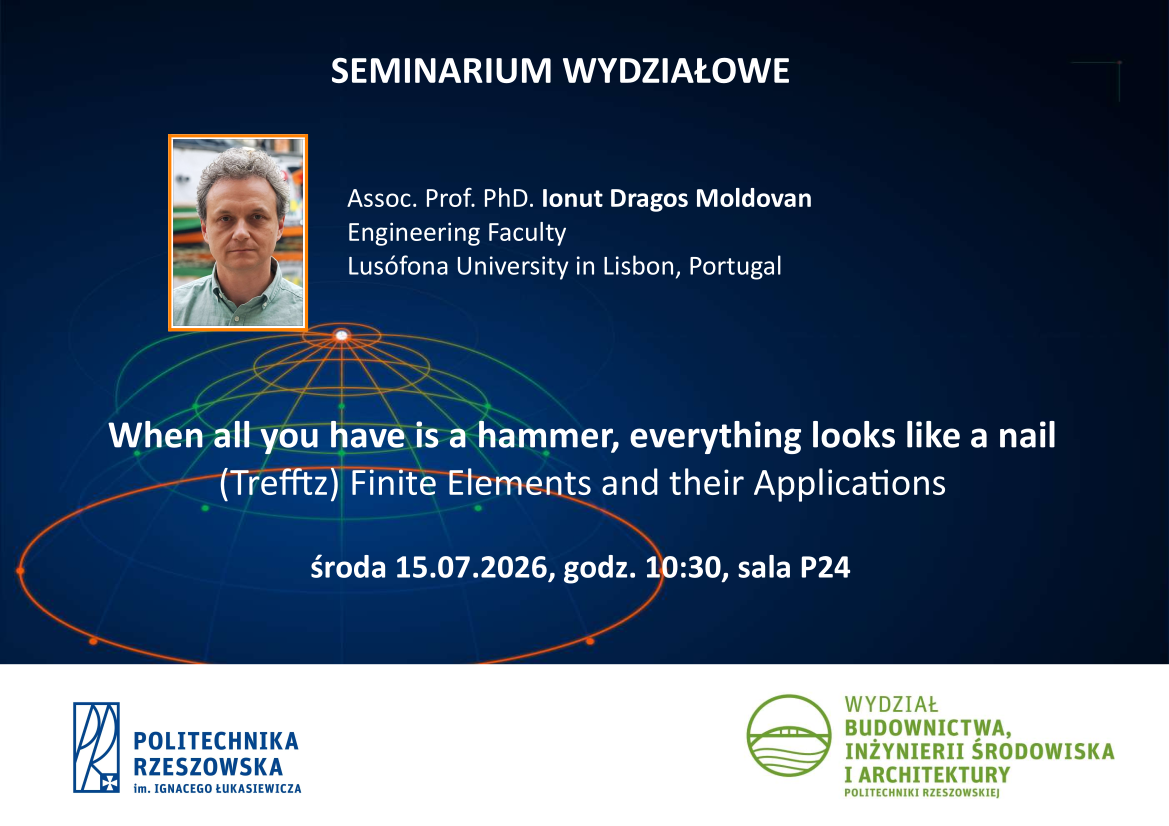
When all you have is a hammer, everything looks like a nail (Trefftz)
Finite Elements and their Applications
środa 15.07.2026, godz. 10:30, sala P24
This is a story about a journey that spans more than 20 years, driven by a simple question: how can advanced computational models move beyond academic prototypes and become practical tools that create value for engineers, infrastructure managers, and society? This lecture presents that journey, beginning with the development of hybrid-Trefftz finite elements for wave propagation, porous media, heat transfer, acoustics, and structural dynamics. Initially confined to a research “sandbox”, these formulations were accessible only to a small group of specialists. Their subsequent evolution into the open-source and user-friendly FreeHyTE platform transformed them into a versatile computational framework capable of addressing a broad range of physical and mathematical problems while promoting reproducibility, accessibility, and scientific collaboration. Opening this computational framework to a wider community also created opportunities to bridge the traditional gap between numerical modelling and experimentation. Particular emphasis is given to the CEN-DynaGeo project, where finite element models were used not only to simulate bender element experiments, but also to automatically interpret measurements and optimize experimental configurations. This work illustrates how numerical models can become active partners in the experimental process rather than merely tools for post-processing and validation. The ability to extract information from measurements naturally led to a broader question: can numerical models become digital proxies of real infrastructure? This theme is explored through Structural Health Monitoring (SHM), where finite element models enriched with monitoring data and machine learning can act as digital representations of structures, supporting damage detection, condition assessment, and maintenance decisions. This perspective further expanded towards emerging challenges such as the adaptation of bridge assets to climate change and the development of methodologies for assessing future structural vulnerability. Many of the concepts developed at the interface between modelling and monitoring proved to be transferable across engineering disciplines. The experience gained in geomechanics and SHM converged in the INTENT project, where concepts originally developed for the dynamic characterization of geomaterials were extended to the continuous monitoring of pavement infrastructures. Embedded bender elements were complemented by the SmartRock technology, creating new opportunities not only for pavement health monitoring but also for traffic detection and characterization. As these technologies matured, a new challenge emerged: making them accessible beyond specialist research groups. The development of the App4SHM smartphone-based toolbox demonstrates how advanced monitoring concepts can be placed in the hands of practitioners and non-specialists, enabling low-cost and scalable assessment of civil infrastructure. The lecture concludes with a reflection on the future role of computational mechanics, sensing technologies, and digital twins in supporting resilient and climate-adapted infrastructure systems. Ultimately, it is a story of taking ideas from theory to practice: from numerical methods developed in isolation to integrated tools that connect modelling, experimentation, monitoring, and decision-making in the real world.
Ionut Dragos Moldovan is an Associate Professor of the Engineering Faculty of the Lusófona University in Lisbon, Portugal. His research interests include the development of non-conventional (hybrid-Trefftz) finite elements with application to Geomechanics, Structural Mechanics, Heat Transfer and Acoustics; and Structural Health Monitoring of Civil Engineering structures, including their adaptation to climate change. Ionut is the Principal Investigator of the research project INTENT (“Intelligent health monitoring of road infrastructures using bender elements embedded in pavements”), funded by the Science and Technology Foundation of Portugal, and participates in two other research projects, at the national and European level. He authored more than 100 scientific publications, including books, book chapters and papers in international journals and conferences. He holds a patent for an innovative procedure for the dynamic characterisation of soils using hybrid-Trefftz finite elements, and is the initiator and lead developer of FreeHyTE, the first public, open-source and user-friendly computational platform using hybrid-Trefftz finite elements, including solvers for transient problems defined of solid and porous (saturated and unsaturated) materials. Ionut is currently supervising six PhD theses in Portugal, Brazil and Romania.


